
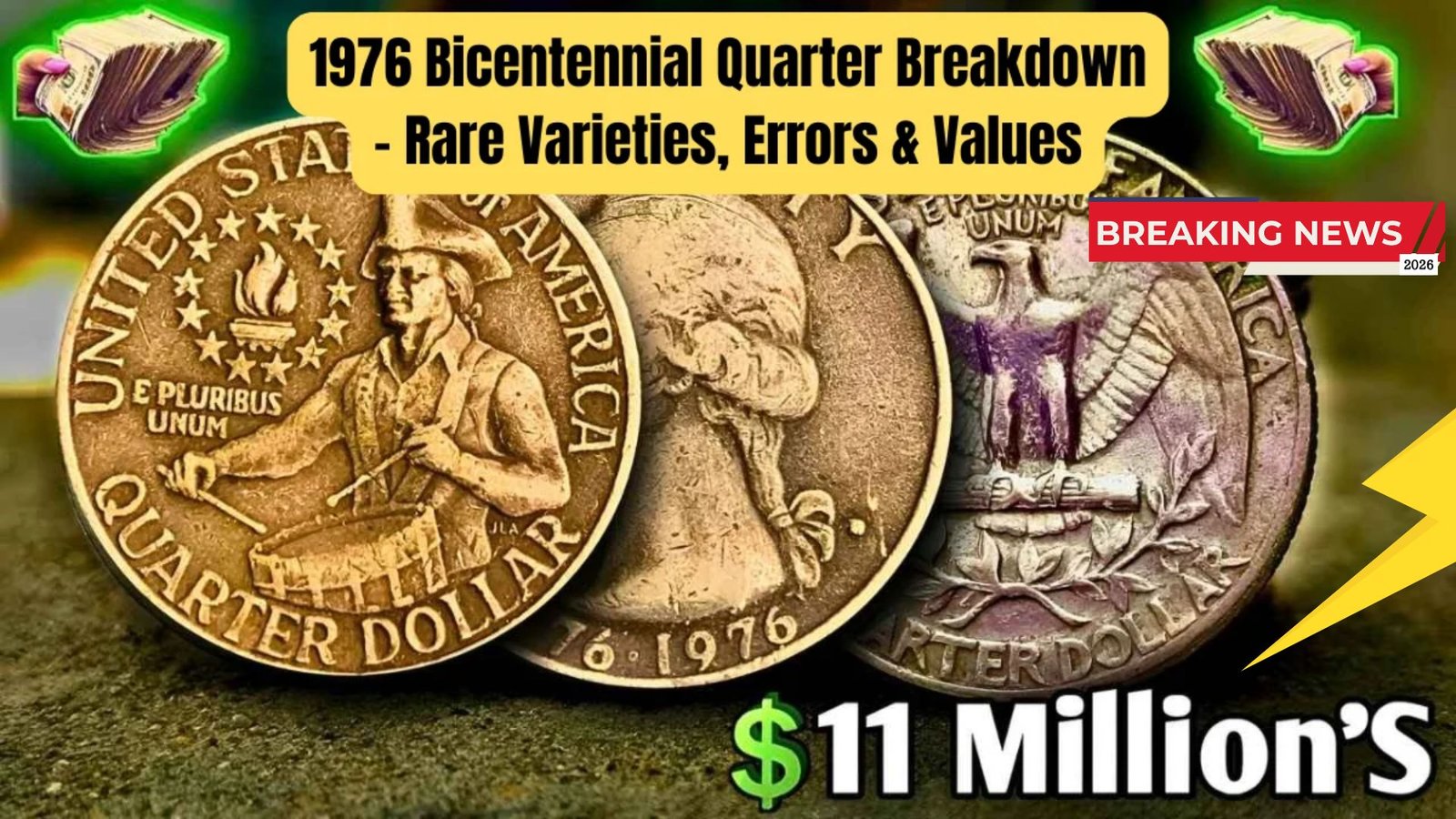
The 1976 Bicentennial Quarter is one of the most familiar and widely collected U.S. coins ever made. Created to celebrate 200 years of American independence, this special quarter looks different from regular Washington quarters and instantly stands out because of its dual date (1776–1976) and its unique reverse design.
At first glance, most Bicentennial quarters seem ordinary and are still found in circulation today. However, beneath the surface, some examples are worth far more than face value. Rare varieties, minting errors, silver composition, and exceptional condition can turn this common-looking coin into a valuable collectible.
This detailed guide explains everything collectors need to know about the 1976 Bicentennial Quarter—its history, design, types, rare errors, values, and what to look for if you think you might have a valuable one.
History of the 1976 Bicentennial Quarter
To honor the United States Bicentennial, the U.S. Mint launched a special coin program in the mid-1970s. Instead of redesigning just one coin, the Mint issued commemorative designs for three denominations:
- Quarter
- Half dollar
- Dollar
Production of the Bicentennial quarter began in 1975, but all coins were issued with the 1776–1976 dual date. As a result, no quarters dated 1975 were released into circulation, making the Bicentennial issue even more distinctive.
The quarter was struck at three different U.S. Mint locations:
- Philadelphia Mint (no mint mark)
- Denver Mint (D mint mark)
- San Francisco Mint (S mint mark)
While most Bicentennial quarters were made for everyday circulation, the San Francisco Mint also produced proof coins and 40% silver versions specifically for collectors. These special editions play a major role in the coin’s value today.
Bicentennial Quarter Design Details
Obverse (Front)
- Portrait of George Washington, based on John Flanagan’s original design
- Dual date: 1776–1976
- Inscriptions: LIBERTY and IN GOD WE TRUST
Reverse (Back)
- Colonial drummer boy holding a drum
- Thirteen stars representing the original colonies
- Torch surrounded by stars
- Inscriptions: UNITED STATES OF AMERICA and QUARTER DOLLAR
The reverse design was created by Jack L. Ahr and selected through a nationwide design competition, making it one of the most symbolic coin designs in U.S. history.
Types of 1976 Bicentennial Quarters
Not all Bicentennial quarters are the same. Their value depends on mint mark, metal content, finish, and condition.
1. Clad Circulation Quarters
- Copper-nickel composition
- Produced in massive numbers
- Commonly found in circulation
- Usually worth face value unless in high grade
2. 40% Silver Bicentennial Quarters
- Struck only at the San Francisco Mint
- Never released into general circulation
- Sold in special collector sets
- More valuable than clad versions
3. Proof Bicentennial Quarters
- Mirror-like finish
- Made specifically for collectors
- Available in both clad and silver versions
Mintage Numbers and General Rarity
Although Bicentennial quarters are not rare overall, certain versions were produced in much smaller quantities.
| Mint | Composition | Estimated Mintage |
|---|---|---|
| Philadelphia | Clad | Over 800 million |
| Denver | Clad | Over 860 million |
| San Francisco | Proof (Clad) | ~7 million |
| San Francisco | 40% Silver (Proof & Uncirculated) | ~11 million |
High mintage alone does not determine value. Errors, silver content, and top-grade coins can still command strong prices.
Rare Varieties of the 1976 Bicentennial Quarter
Type I vs Type II Reverse (Proof Coins)
Proof Bicentennial quarters from San Francisco come in two reverse styles:
- Type I Reverse
- Thicker lettering
- Softer details
- Type II Reverse
- Sharper lettering
- Cleaner, more detailed design
Type II proof quarters are scarcer and more valuable, especially in higher grades.
High-Grade Mint State Coins
Because these coins were widely circulated, finding examples graded MS67 or higher is extremely difficult. Coins in these top grades often sell for hundreds or even thousands of dollars.
Valuable Mint Errors to Look For
Minting errors are the biggest reason some Bicentennial quarters sell for far more than face value.
Double Die Errors
- Doubling visible on lettering, date, or drummer details
- Caused by die misalignment
- Highly collectible
Off-Center Strikes
- Design appears shifted off-center
- Greater offset usually means higher value
Broadstrike Errors
- Coin struck without a retaining collar
- Results in a wider, flatter coin
Clipped Planchets
- Missing metal along the edge
- Can be curved or straight
Wrong Planchet Errors
- Coin struck on a blank meant for another denomination
- Extremely rare and valuable
Current Market Values (2026 Estimates)
Here is a realistic look at what collectors are paying today:
| Coin Type | Condition | Approximate Value |
|---|---|---|
| Clad (P or D) | Circulated | $0.25 – $0.75 |
| Clad (P or D) | MS65 | $5 – $15 |
| Clad (P or D) | MS67+ | $200 – $2,000 |
| Proof Clad (S) | PR65+ | $5 – $12 |
| 40% Silver (S) | Proof | $10 – $30 |
| Double Die Error | Any | $150 – $1,500 |
| Off-Center Error | Visible | $100 – $1,000 |
| Wrong Planchet Error | Any | $2,000+ |
Prices vary based on demand, eye appeal, and grading accuracy.
How Condition and Grading Affect Value
Condition plays a huge role in determining value. Even common Bicentennial quarters can become valuable if preserved well.
Key grading factors include:
- Surface preservation
- Sharpness of strike
- Original luster
- Contact marks
- Overall eye appeal
Professional grading by a recognized service greatly increases buyer confidence and resale potential.
How to Identify a Silver Bicentennial Quarter
Silver versions are often confused with regular clad quarters.
Quick ways to tell the difference:
- Edge: Silver coins show little or no copper stripe
- Weight: Silver quarters are heavier
- Sound: Silver produces a higher-pitched ring
Only San Francisco collector issues were struck in 40% silver.
Collecting Strategies for Bicentennial Quarters
Collectors approach these coins in many ways:
- Three-mint complete sets
- Error-only collections
- Silver-only sets
- High-grade registry collections
Because of their strong historical appeal, Bicentennial quarters remain popular with both beginners and experienced collectors.
Long-Term Value Outlook
Most circulated Bicentennial quarters are unlikely to rise dramatically in value. However, rare errors, silver versions, and top-grade examples continue to appreciate steadily.
Their connection to American history and ongoing collector demand gives them lasting appeal in the numismatic market.
Final Thought
The 1976 Bicentennial Quarter is far more than ordinary pocket change. Behind its familiar design is a fascinating world of rare varieties, mint errors, silver compositions, and valuable high-grade coins. Whether you are casually checking spare change or building a focused collection, understanding this historic quarter can turn a simple find into a meaningful and sometimes valuable discovery.