
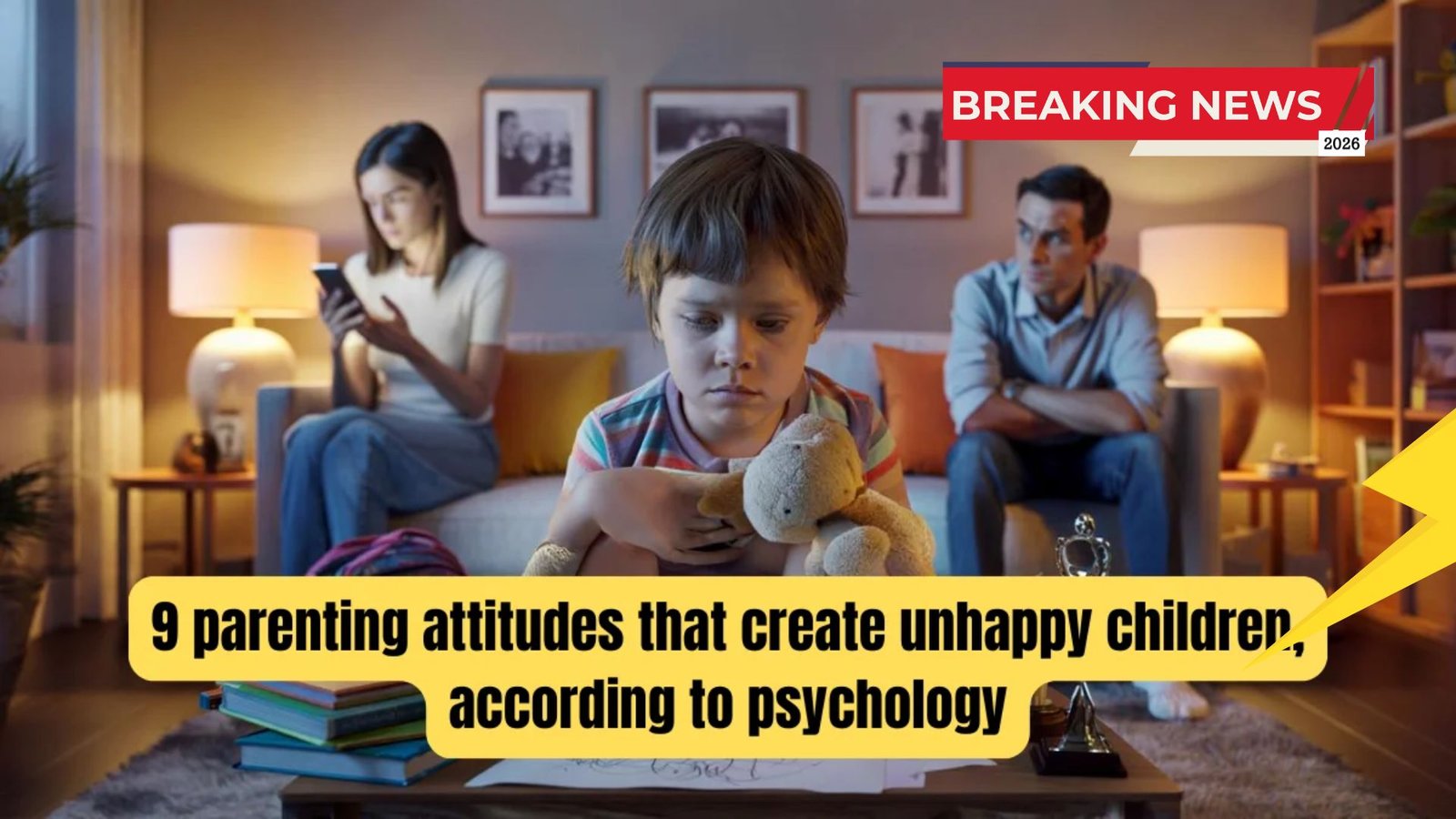
Parenting is one of the most emotionally demanding roles a person can take on. Most parents genuinely love their children and want the best for them. Still, psychology shows that even well-meaning parents can unknowingly develop everyday attitudes that slowly affect a child’s emotional well-being. These attitudes are not always dramatic or intentional. They are often subtle patterns repeated over time through words, reactions, and emotional responses.
According to psychology, children are shaped not only by what parents do, but by how parents respond emotionally to their needs. Small behaviors, when repeated daily, can leave deep emotional marks. This article explains nine parenting attitudes that psychology links to unhappy children, focusing only on the information presented in the source.
Conditional Love and Approval
When children feel that love must be earned, their sense of self-worth becomes fragile. Parents who mainly show affection, praise, or attention only when a child performs well in school, behaves perfectly, or meets expectations may unintentionally send a message that love depends on success.
Over time, children raised with conditional approval begin to believe they are valuable only when they achieve or please others. Their emotional security becomes tied to performance rather than acceptance.
Psychology explains that this attitude can lead children to fear mistakes. Instead of learning and exploring freely, they focus on avoiding failure and disappointing their parents. This can shape a child’s emotional world in lasting ways.
Excessive Control and Micromanagement
Some parents try to manage every detail of their child’s life, including choices, routines, opinions, and emotions. While this often comes from a desire to protect, psychology shows that excessive control can limit emotional independence.
Children need age-appropriate freedom to make decisions, face small consequences, and learn to trust their own judgment. When parents remove these opportunities, children may struggle to develop confidence.
Psychological research links overcontrol with anxiety and dependence. Children raised this way may grow up unsure of themselves or become rebellious later in life as a reaction to constant restriction.
Emotional Invalidation
Emotional invalidation happens when a parent dismisses a child’s feelings instead of acknowledging them. Statements that downplay emotions can make children feel misunderstood or ignored.
Psychology explains that when children are repeatedly told their feelings are wrong or unimportant, they learn to suppress emotions rather than understand them. These emotions do not disappear. Instead, they often resurface as stress, anger, or emotional numbness.
Over time, emotional invalidation can make children unsure about how they feel and hesitant to express emotions openly.
Constant Criticism and Negative Focus
Children who grow up hearing more criticism than encouragement often develop a harsh inner voice. Constant focus on mistakes, even through subtle comments or comparisons, shapes how children see themselves.
Psychology shows that children internalize parental criticism. What begins as external judgment becomes self-criticism that can continue into adulthood.
This attitude can slowly reduce a child’s confidence. Instead of feeling capable, children may become overly cautious, afraid of judgment, and unsure of their abilities.
Emotional Unavailability
Some parents provide structure, education, and physical care but remain emotionally distant. Emotional unavailability can include limited affection, lack of attentive listening, or minimal emotional engagement.
Children need more than basic care. Psychology emphasizes that emotional connection plays a key role in healthy development. When children feel emotionally ignored, they may believe their needs are a burden.
This can affect how children form relationships later in life, making closeness and trust more difficult.
Unrealistic Expectations
Unrealistic expectations place heavy emotional pressure on children. This includes expecting constant success, emotional maturity beyond a child’s age, or achievement aligned with parental dreams rather than the child’s abilities.
Psychology links these expectations to chronic stress in children. When children feel they are never “enough,” they may develop fear of failure and emotional exhaustion.
Children need space to grow at their own pace. Pressure without flexibility can lead to burnout even at a young age.
Inconsistent Parenting
Inconsistent parenting occurs when rules, discipline, or reactions change unpredictably. Children may experience strict behavior one day and permissiveness the next, depending on a parent’s mood.
Psychology explains that inconsistency creates emotional uncertainty. Children struggle to understand boundaries and may feel anxious when they cannot predict how a parent will react.
Consistency helps children feel safe. Without it, emotional insecurity can grow, affecting trust and behavior.
Using Guilt, Shame, or Fear as Control Tools
Some parents rely on guilt, shame, or fear to control behavior. These methods may result in short-term obedience, but psychology shows they can harm emotional development.
When children are made to feel ashamed or fearful to gain compliance, they learn obedience without understanding. This weakens internal responsibility and emotional health.
Over time, children may develop chronic guilt, poor self-image, and difficulty setting personal boundaries.
Ignoring the Child’s Individual Identity
Every child has a unique personality, interests, and emotional needs. When parents expect children to mirror their own beliefs, choices, or life paths, children may feel unseen.
Psychology explains that ignoring a child’s individuality can lead to identity confusion. Children may hide their true selves to gain approval.
This attitude can result in emotional disconnection and long-term struggles with self-identity.
Parenting Attitudes and Their Emotional Effects
| Parenting Attitude | Common Behavior | Emotional Effect on Child |
|---|---|---|
| Conditional love | Praise only for success | Low self-worth |
| Excessive control | No autonomy allowed | Anxiety, dependence |
| Emotional invalidation | Dismissing feelings | Emotional suppression |
| Constant criticism | Focus on mistakes | Self-doubt |
| Emotional unavailability | Lack of warmth | Loneliness |
| Unrealistic expectations | High pressure | Burnout |
| Inconsistent parenting | Unpredictable rules | Insecurity |
| Guilt-based control | Shame and fear tactics | Chronic guilt |
| Ignoring identity | Forcing conformity | Identity confusion |
Conclusion
This article highlights how parenting attitudes can shape a child’s emotional well-being in powerful ways. Psychology shows that unhappy children are not usually the result of a lack of love, but of repeated emotional patterns that affect how children see themselves and the world around them.
Understanding these unhappy children psychology patterns helps parents recognize how everyday behaviors influence emotional health. Awareness of these attitudes allows parents to better support emotional security, confidence, and healthy development as children grow.