
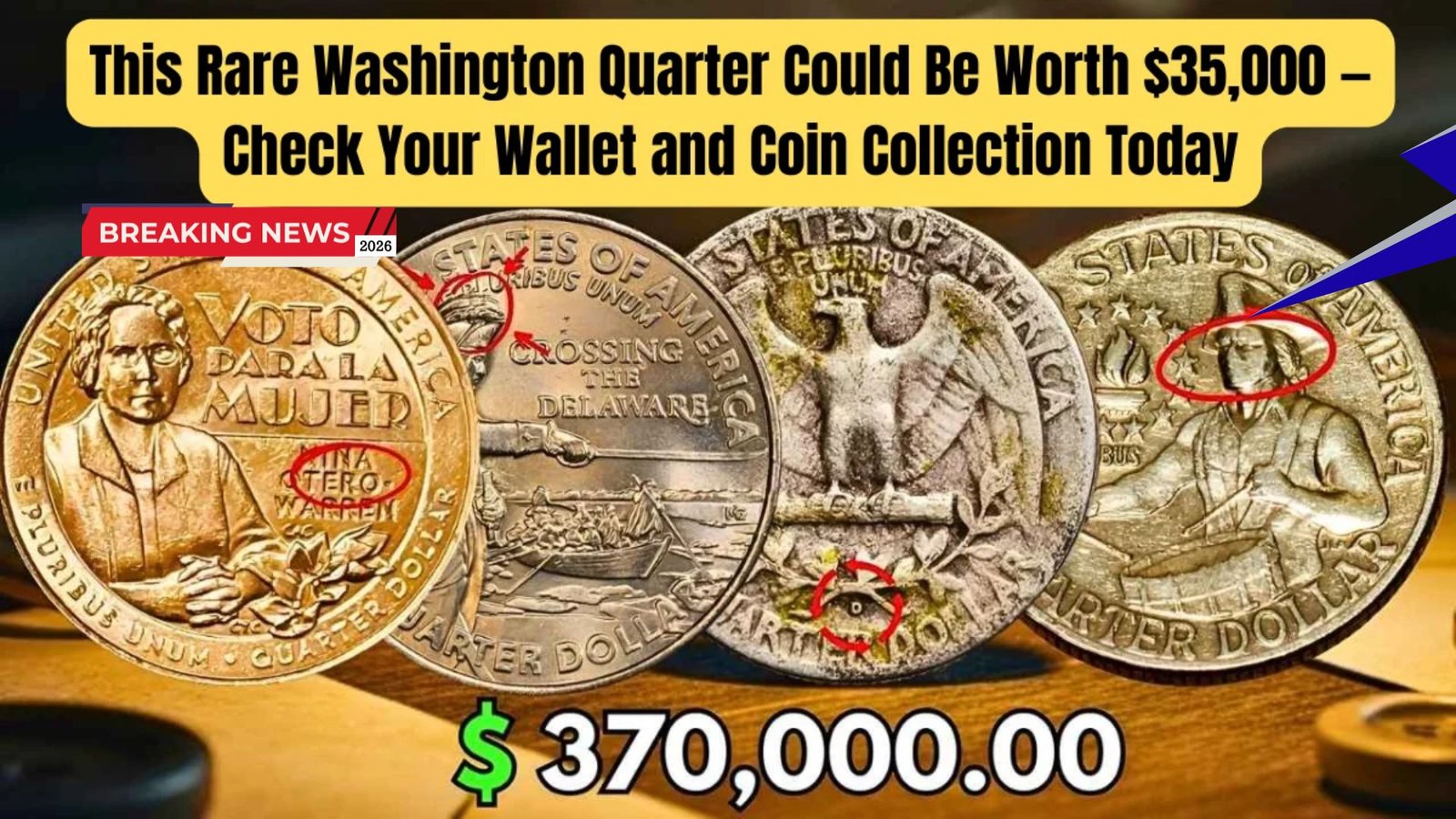
Most people rarely think twice about the loose change sitting in their wallet, drawer, or old piggy bank. Coins are often seen as everyday items with little value beyond their face amount. However, certain coins have historically become highly valuable collectibles. Among them, a rare Washington Quarter has recently been highlighted for fetching prices up to $35,000 at auctions.
If you have inherited old coins or collected spare change over the years, now is the perfect time to examine your quarters. Even a coin worth just 25 cents could potentially hold life-changing value. Understanding what makes this Washington Quarter so special can help determine if you already own one.
The History of the Washington Quarter
The Washington Quarter was first minted in 1932 to commemorate the 200th birth anniversary of George Washington, the first President of the United States. Originally intended as a one-year commemorative coin, its popularity led to permanent production.
Sculptor John Flanagan designed the coin, featuring Washington’s profile on the obverse and an eagle with outstretched wings on the reverse in earlier editions. Over the years, design changes occurred, but the Washington Quarter remained a staple of U.S. currency.
Although millions of these coins were produced, some were struck under rare circumstances, creating varieties that are now highly prized by collectors.
Why Some Washington Quarters Are Extremely Valuable
Not all Washington Quarters carry high value. The key factors that make certain quarters collectible include:
- Low mintage numbers
- Minting errors
- Exceptional condition
- Historical significance
- High collector demand
When these elements converge, a single quarter can be worth tens of thousands of dollars.
The Rare Washington Quarter Worth Up to $35,000
One of the most sought-after quarters is the 1932-D Washington Quarter, minted at the Denver Mint. Only 436,800 of these coins were produced, making it one of the lowest-mintage Washington Quarters ever.
Coins in excellent condition, especially with sharp details and minimal wear, have sold for as much as $35,000.
Mint Marks and Their Importance
Mint marks help identify where a coin was produced and can indicate rarity. In 1932, Washington Quarters were minted in three locations:
- No mint mark – Philadelphia
- D – Denver
- S – San Francisco
Among these, the Denver (D) and San Francisco (S) versions are rarer than Philadelphia coins. The 1932-D stands out for its low production, making it particularly valuable to collectors.
Minting Errors That Boost Value
Minting errors can also increase a coin’s worth. These errors occur during the production process and create unique features that are rare or unrepeatable. High-value minting errors include:
- Double die errors: Parts of the design appear doubled
- Off-center strikes: Design misaligned
- Clipped planchets: A portion of the coin is missing
- Wrong metal composition: Coin struck on incorrect planchet
Even common Washington Quarters can become extremely valuable if they contain a rare, well-documented error.
Condition Matters: Why Grading Is Key
Condition is one of the most important factors in a coin’s value. Coins in Mint State (MS) condition—never circulated—are far more valuable than worn coins. Small details such as hair strands, eagle feathers, and rim sharpness significantly impact pricing.
Professional grading services certify a coin’s condition, adding authenticity and trustworthiness, which helps in selling or auctioning rare coins.
Table: Valuable Washington Quarter Varieties and Estimated Values
| Year | Mint Mark | Key Feature | Condition | Estimated Value |
|---|---|---|---|---|
| 1932 | D | Low mintage | Mint State | Up to $35,000 |
| 1932 | S | Scarce issue | Mint State | Up to $25,000 |
| 1942 | None | Double die error | Very Fine+ | Up to $20,000 |
| 1950 | D | Off-center strike | Uncirculated | Up to $15,000 |
| 1965 | None | Transitional error | Mint State | Up to $12,000 |
Values depend on condition, rarity, and market trends.
How to Check Your Wallet and Coin Collection
You don’t need to be a professional collector to identify valuable quarters. Here’s a simple approach:
- Sort quarters by year: Focus on coins from 1932, especially those with D or S mint marks.
- Inspect closely: Look for unusual features such as doubling, off-center designs, or missing details.
- Use a magnifying glass: Fine details often go unnoticed with the naked eye.
- Avoid cleaning coins: Cleaning can damage surfaces and reduce value.
Where Rare Quarters Are Often Found
Rare Washington Quarters have been discovered in:
- Old family coin jars
- Inherited collections
- Bank-wrapped rolls of quarters
- Estate sale items
- Drawers and storage boxes
Because many people are unaware of coin values, these quarters sometimes circulate unnoticed for decades.
Professional Evaluation and Authentication
If you suspect a quarter is valuable, consider professional grading. Certification verifies authenticity, confirms condition, and establishes market value. A graded coin is easier to sell and often fetches higher prices at auctions.
Why Collector Demand Keeps Prices High
The Washington Quarter series is highly popular due to historical significance and long production. Completing a set, especially including rare 1932-D coins, is a goal for many collectors. Limited supply combined with strong demand keeps values high and, in some cases, rising.
Long-Term Investment Potential
Rare coins like the Washington Quarter are considered alternative assets. Historically significant coins with low mintage tend to hold value over time, making them both collectibles and investment pieces.
Conclusion
A simple quarter could be worth tens of thousands of dollars. Rare Washington Quarters, particularly the 1932-D in Mint State or coins with minting errors, continue to surprise collectors and everyday individuals alike.
Take a few minutes to check your wallet, coin jars, or inherited collections—you might uncover a hidden treasure. Even if you don’t find a $35,000 coin, learning about these rare quarters brings a new appreciation for the coins we often overlook.
Sometimes, history hides in plain sight — and it may already be in your pocket.